# Responsive HTML email signature(s)
[](https://www.npmjs.com/package/responsive-html-email-signature)
[](/LICENSE)
[](https://github.com/danmindru/responsive-html-email-signature/actions)
### Let's punch email clients in the stomach 👊
When you need some basic responsive email signatures that work on mobile.
...and your colleagues need them too.
...but you don't want to deal with tables and inline styles.
[Read the docs in other languages](/i18n) ↗️
## Preview
Here are some examples:


## Getting started
- Clone repo `git clone https://github.com/danmindru/responsive-html-email-signature.git`
- Run `npm install`
- Run `npm start` to generate templates from configuration. This will continue to watch your files and re-make the template until you exit.
### Customizing templates
- Edit files in _/templates_
- Open files from `./dist` in your fav browser to check them out
> When you're done, check out [how to add them to your email client of choice](#usage-with-different-email-clients) if in doubt.
## Motivation
Writing HTML emails & email signatures sucks. Let's make it easier. We can't fix all email clients, but we can surely make our lives easier with some automation.
## What does this pile of code do
- [x] generates email templates from your config
- [x] allows generating multiple templates at once (for your colleagues too!)
- [x] transforms linked (``) CSS into inline styles
- [x] embeds local `img[src]` into the template (base64).\*
- [x] minifies the template
- [x] ads some basic media queries for mail clients that support them
- [x] can build templates from multiple sources
- [x] watches HTML / CSS files for changes and re-builds
- [x] supports LESS / SASS / PostCSS
- [x] autoprefixer, so you don't have to worry about your `-moz-`s or `-webkit-`s
- [x] linting, checks for used template config parameters and more!
\*_Some mail clients might have [hard limits](https://support.google.com/a/answer/176652?hl=en) regarding the email size, so don't include large images if possible. If you need to, use a URL instead and host the image somewhere else._
## Docs
### Installing
```bash
$ npm install
$ npm start # By default, templates will be created in `./dist` and HTML & CSS files in './templates' will be watched for changes.
```
> Note: works well with node v10+. Earlier and later versions might also work.
### Configuring
To make a basic email from existing templates, you only have to edit the `conf.json` file in each template.
For example, the dark template accepts the following:
```json
{
"id": "",
"signature": "",
"name": "",
"contactMain": "",
"contactMail": "",
"slogan": "",
"logoUrl": "",
"logoAlt": "",
"website": ""
}
```
### Generating multiple emails from the same config (for your colleagues too!)
To generate multiple templates, use an array instead of an object in `conf.json`, like so:
```json
[{ ...conf1 }, { ...conf2 }]
```
### Using config values in HTML
Config variables are made available in all HTML files.
Add any variable to the configuration file and use it in HTML like so:
```html
```
Where the configuration contains:
```json
{
"yourCustomVariable": "Custom!"
}
```
> NB: config variables also accept HTML. That's useful for including links.
### Adding CSS & pre-processing
Any number of CSS, SASS or LESS files in a template directory & they will be automatically processed & inlined into the files outputed in `./dist`.
### Multiple emails in the same template
Templates can contain multiple HTML files from which to build emails. For example, the dark template has `signature.html` and `signature-reply.html`, which is a simpler version.
Each HTML file will be treated as an email template, except for `*.inc.html`. See below ⬇️
### Using partials (\*.inc.html)
By naming files with `*.inc.html`, they become partials. Partials will not be treated as templates (ignored), but they can be included in any HTML template using the `@include` HTML comment.
```html
There are 2 examples of template structures, one for the `light` email template and one for the `dark` one.
Here's how the dark one is structured:
```bash
./templates
├── dark
├── assets
├── dark.png # Image to embed as base64
├── conf.json # Template strings, logo, etc.
├── dark.css # Stylesheet.
├── footer.inc.html # Contact info & logo
├── head.inc.html # 'Responsive' CSS goes here
├── signature.html # Full signature (loads head/footer)
├── signature-reply.html # Simplified signature (loads head)
```
Here's how the light one is structured:
```bash
./templates
├── light
├── assets
├── light.png # Image to embed as base64
├── conf.json # Template strings, logo, etc.
├── footer.inc.html # Contact info & logo
├── full-mail.html # Body + signature
├── head.inc.html # 'Responsive' CSS goes here
├── light.css # Stylesheet.
├── signature.html # Full signature (loads head/footer)
├── signature-reply.html # Simplified signature (loads head)
```
There's one convention you have to keep in mind: `all files that you wish to include should follow the *.inc.html format`. The gulp task ignores `*.inc.html` files, but will try to process & create email templates from all `.html` files.
You are of course encouraged to change the default structure for your use case.
## Overview of the build process
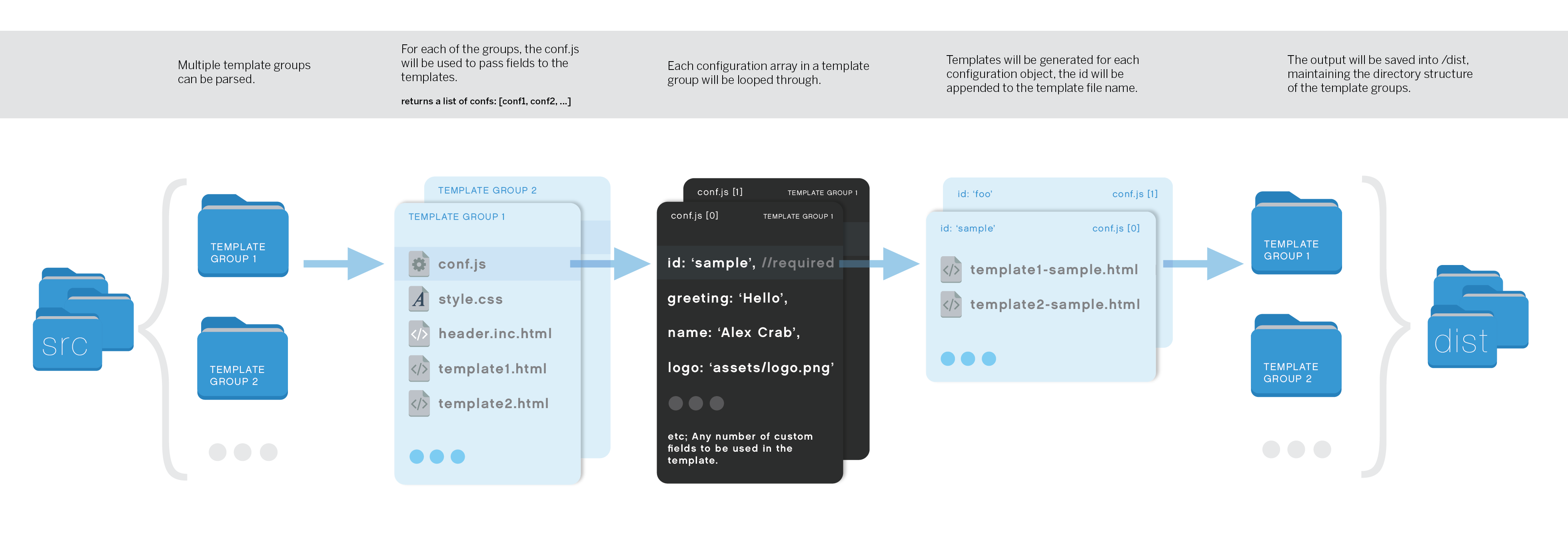
The diagram below shows what happens to your email templates.
Each folder in 'templates' is considered a `template group`. A template file will be generated for each of the configuration objects you add have in the template group -> `conf.js`.
## CSS Support
Remember, it's HTML mails, so you need to check a big-ass table to find out nothing's gonna work.
See [this](https://www.campaignmonitor.com/css/) for more info. [Gulp-inline-css](https://www.npmjs.com/package/gulp-inline-css) is being used to convert whatever CSS you throw at it to inline styles, but it probably won't handle everything.
Some bonuses of using `gulp-inline-css`: many css props will be converted to attributes. For example, the 'background-color' prop will be added as 'bgcolor' attribute to table elements.
For more details take a look at the [inline-css mappings](https://github.com/jonkemp/inline-css/blob/master/lib/setTableAttrs.js).
## Usage with different email clients
### Thunderbird
There are several Thunderbird plugins which can automatically insert signatures when composing e-mails. We recommend [SmartTemplate4](https://addons.mozilla.org/en-us/thunderbird/addon/smarttemplate4) as one of the options. It can use different templates for new e-mails, replies and forwarded e-mails.
### Gmail
Go to your mailbox settings & paste the generated signature.
> **NB**: Gmail doesn't seem to support inlined (base64) images. You have to use absolute `http(s)//...`.
### Office 365 / outlook.live.com
It's a bit hacky to set up, but possible. See [this issue](https://github.com/danmindru/responsive-html-email-signature/issues/52).
### Apple Mail / OS X (oh boy)
#### Solution 1
- Open Mail.app and go to `Mail` -> `Preferences` -> `Signatures`
- Create a new signature and write some placeholder text (doesn't matter what it is, but you have to identify it later).
- Close Mail.app.
- Open terminal, then open the signature files using TextEdit (might be different for iCloud drive check the article below).
```
$ open -a TextEdit ~/Library/Mobile\ Documents/com~apple~mail/Data/V3/MailData/Signatures/ubiquitous_*.mailsignature
```
- Keep the file with the placeholder open, close the other ones.
- Replace the `...` and it's contents with the template of your choice. _Don't remove the meta information at the top!_
- Open Mail.app and compose a new mail. Select the signature from the list to test it out.
> **NB**: Images won't appear in the signature preview, but will work fine when you compose a message.
#### Solution 2
You can also open the HTML files in `/dist` in a browser, CMD + A, CMD + C and then paste into the signature box. This won't copy the `` part or the `